Falcoria
Falcoria is a system for team-based port scanning on large scopes. It maintains a shared scope state that every scan updates — no separate files to merge.
The problem
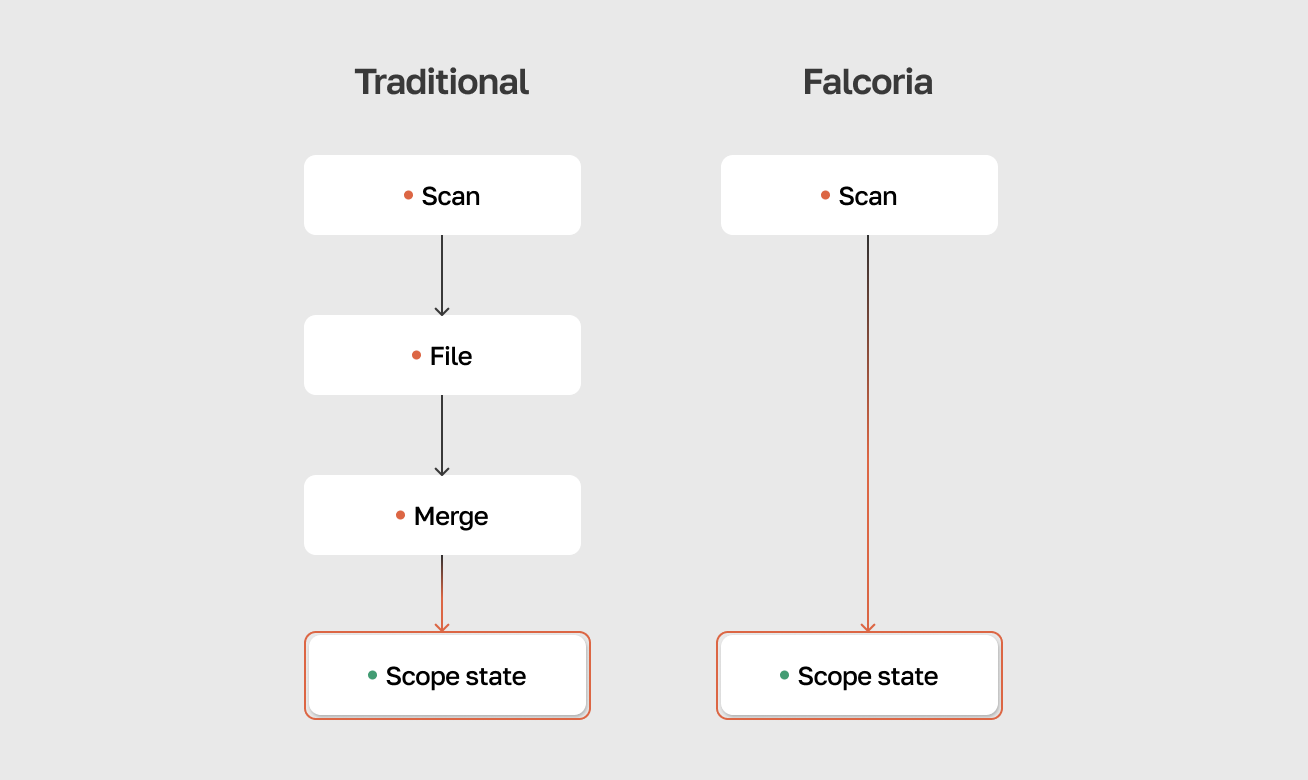
On a large engagement, scan output multiplies fast. Different people use different tools, the scope gets split into chunks, rescans add more files. After a few days, there's no single place to check what's open — the answer is spread across dozens of files from different people and points in time.
Teams deal with this using whatever is at hand — shared folders, spreadsheets, Notion, Slack. None of these are built for scan data, and the results still have to be merged.
How Falcoria approaches this
Falcoria treats scans as state updates. Each scan — whether Falcoria's own or an imported report — writes directly into a shared dataset called ScanLedger. There is no intermediate file step.
What this gives you
-
Shared scope state — each scan updates a persistent shared dataset. No intermediate files or manual merge steps — every team member sees the same current scope state immediately after a scan completes.
-
Import modes — operator controls how each scan is applied — HTTP-only first, then full range, then service detection — each pass adds to the same result without overwriting previous data. The system parses scan commands to know which ports were in scope — ports in range but absent from results are marked as closed.
-
Change tracking — records state transitions between scans: newly opened ports, closures, service changes. No manual diffing of scan outputs.
-
Deduplication — eliminates redundant targets before scanning starts. Different team members can submit overlapping targets — each is scanned only once. Deduplication cuts the scope by ~20% to nearly 50% before a single packet is sent. Fewer duplicate probes, lower network noise, reduced risk of triggering rate limits.
-
Distributed execution — splits work across multiple workers on separate machines and network paths. Ten workers scan roughly ten times faster than one, without increasing the rate on any single target. See Benchmarks for measured results.
-
Resumable scans — interrupted scans pick up where they left off. The task queue tracks completed units of work.
-
Export — the current scope state can be generated as Nmap XML or JSON at any time, preserving compatibility with existing tooling.
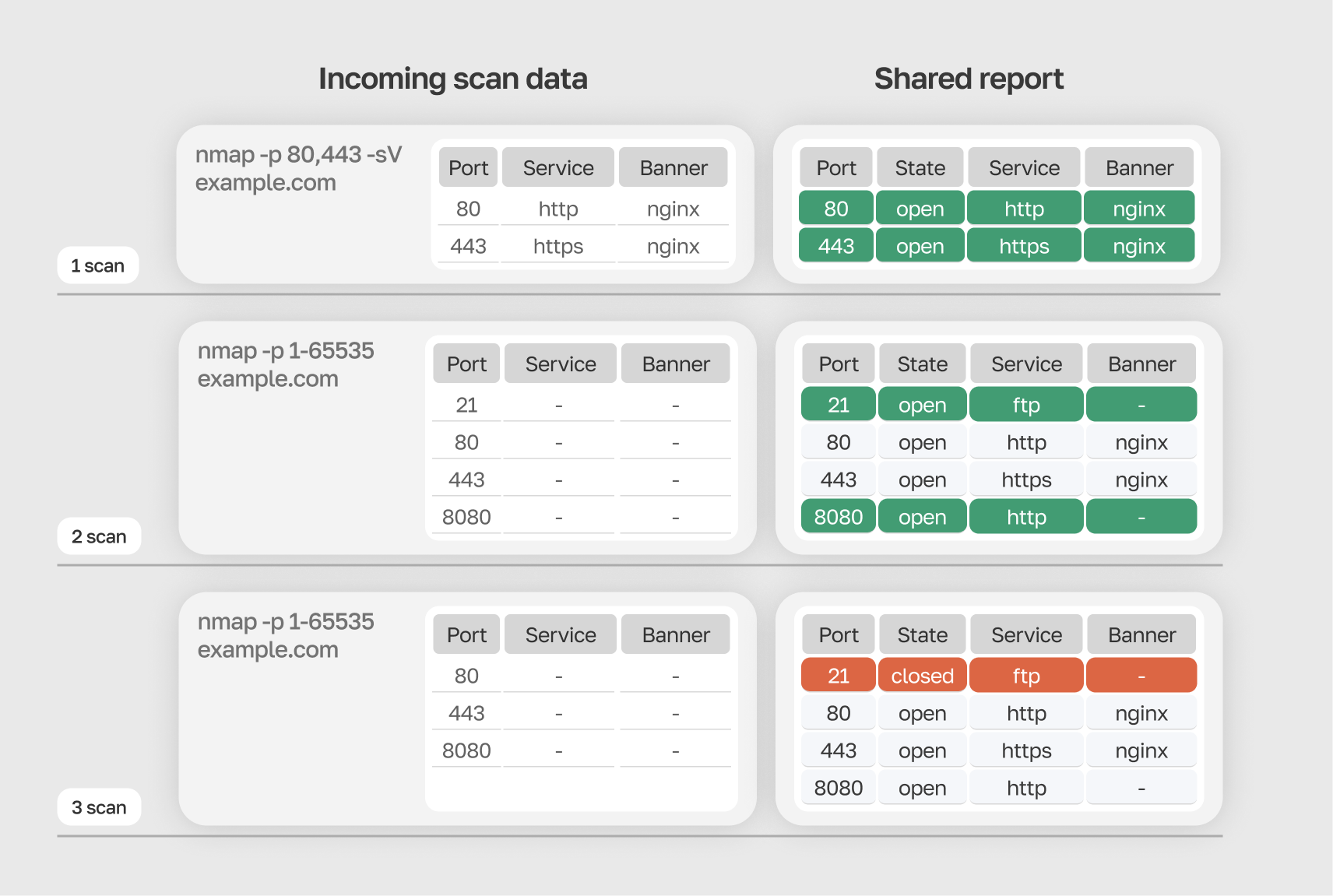
Scope state evolving across three scans: ports are added, services detected, changes tracked.
Who it is for
- Penetration testers managing large scopes with a team
- Red team operators running repeated discovery across changing networks
- Security engineers maintaining current host/port/service visibility
- Security automation teams looking for an API-driven backend to aggregate scan data from various sources
Next steps
- Getting Started — setup and first scan
- Architecture — how the system is structured
- Concepts — how the pipeline works end to end
- Workflows — common usage patterns